Wouldn't It Be Nice by Charles L. Granata
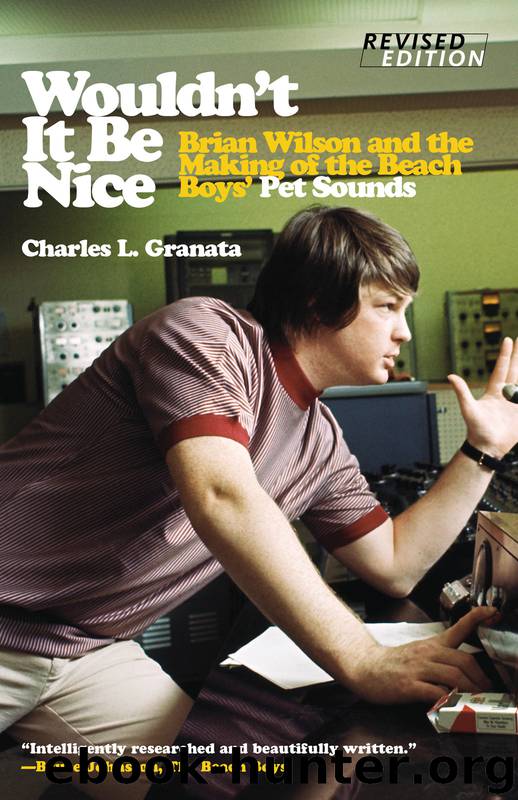
Author:Charles L. Granata
Language: eng
Format: epub
Publisher: Chicago Review Press
Published: 2016-03-16T04:00:00+00:00
On the Date: The Instrumental Tracking Sessions
Brian stored the ideas for his unusual musical gestures in his head until the day of recording. And since he arranged and rehearsed the songs in sections, the musicians rarely heard an entire tune until they began to record it. “Brian’s dates were completely disorganized,” says accordionist Frank Marocco. “When you first walked in, it was like chaos—you never knew what was going to happen. You’d be thinking, ‘Geez, how is this going to end up sounding like something?’ But by the end of the session it would come together and sound like what Brian had in mind all along. I sometimes think he put it together as he went along.”
The unstructured studio atmosphere was deceiving—a mask for Brian’s restlessness. “As disorganized as he could otherwise be, when Brian was in the studio you got the impression that if he didn’t get his ideas down on tape as quickly as possible, they’d slip away from him,” says Tony Asher. “He wanted to keep things moving, and he drove the guys a little. He created just the right amount of tension to get what he wanted done.” Despite outward appearances, however, there was always a plan. Before the session, Brian would sit for hours, working out keys and chord structures at the piano. And while he generally stuck to this mental blueprint, he always welcomed suggestions from the band.
“Artists nowadays say, ‘We should go into the studio and experiment. Let’s just try shit,’” says producer Rob Fusari. “And I say, ‘No!’ Because what they want to do is go in with no preconceptions, and see what comes out. The way Brian conducted his sessions demonstrated the very best in experimentation, because they always had direction. Brian understood that once he had a clear direction, then he could experiment. That’s when the experimenting really results in something—when the artist or producer has a vision and uses the tools available to him to flesh those ideas out and refine them. It seems like Brian always went into the studio with a firm idea of what he wanted yet wasn’t so married to it that he couldn’t accept new ideas from his musicians. That’s the ultimate way to experiment: with direction, guidance, and flexibility. No producer that I can think of did that better than Brian Wilson.”
“Brian had a broad scope of musical knowledge,” says percussionist Frank Capp. “Sometimes he knew what he wanted to hear, but not how to achieve the sound. He might say, ‘I want something shimmery,’ or ‘I want it to sound like something blowing in the wind.’ I’d suggest a percussive effect to suit the image he had in mind. I had a plethora of percussion instruments and gimmicks at that time, so I could usually find something that would work. I’d play him two or three things, and he would choose what he liked best. On other occasions, he knew exactly what he wanted, and would call for that. It was a cooperative thing; we contributed our ability and talent to what he had in mind.
Download
This site does not store any files on its server. We only index and link to content provided by other sites. Please contact the content providers to delete copyright contents if any and email us, we'll remove relevant links or contents immediately.
Cecilia; Or, Memoirs of an Heiress — Volume 2 by Fanny Burney(32012)
Cecilia; Or, Memoirs of an Heiress — Volume 3 by Fanny Burney(31997)
Fanny Burney by Claire Harman(26663)
We're Going to Need More Wine by Gabrielle Union(19110)
Plagued by Fire by Paul Hendrickson(17465)
All the Missing Girls by Megan Miranda(16326)
Cat's cradle by Kurt Vonnegut(15446)
For the Love of Europe by Rick Steves(14587)
Bombshells: Glamour Girls of a Lifetime by Sullivan Steve(14138)
Leonardo da Vinci by Walter Isaacson(13413)
4 3 2 1: A Novel by Paul Auster(12517)
The remains of the day by Kazuo Ishiguro(9091)
Adultolescence by Gabbie Hanna(8965)
Note to Self by Connor Franta(7702)
Diary of a Player by Brad Paisley(7653)
Giovanni's Room by James Baldwin(7441)
What Does This Button Do? by Bruce Dickinson(6263)
Ego Is the Enemy by Ryan Holiday(5530)
Born a Crime by Trevor Noah(5433)
